Saturday, April 12, 2008

How to spend $1000 in five minutes at a winery


Above is a packet of dehydrated lactobacilli - our little microbial friends who turn malic acid into lactic acid.


This is five minutes later - five malolactic inoculations ready to rock - at the cost of $1000 a packet, these are some expensive measuring jugs!

Malolactic fermentation (MLF) is the process where lactobacilli convert malic acid, which is more acidic, into the less acidic lactic acid. This lowers the pH of the wine and also creates a rounder mouthfeel - lactic acid is the main acid in milk! Malolactic Fermentation is a must for all red wines and most whites - your steely unoaked chardonnays and rieslings are prevented from going through malolactic fermentation to retain more "crispness" in the mouth and keep the acid at a palate cleansing level.

For years scientists couldn't understand what was in it for the lactobacilli since no energy is released when malic acid is converted into lactic acid. Very recently however it has been shown that the electrochemical gradient of having a higher pH inside the bacterial cell (all the malic acid) and the lower pH outside the cell (the wine now having lactic acid instead) is high enough for the bacilli to use it as a generator (think of a battery - the voltage is the electrical gradient between the two terminals). Amazing, huh? Life will always find a niche!

Monday, April 7, 2008

Random Harvest Photo

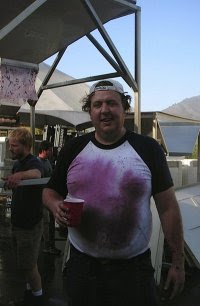
Sophie Matthews rocking the morning Pinot Noir punchdowns.

Sunday, April 6, 2008

Day 3: Gewürztraminer


After almost two days on the skins we drained the free run Gewürztraminer juice out of tank and then pressed the left over skins for the rest of the juice. As you can see the free run has this "pinky" tinge to it from its time on the skins. As soon as it appears it is gone. The picture below is from just an hour later.

Once we sent all the free run juice to tank we then pressed the skins in this massive press which slowly inflates and deflates its bladder over a two hour period to extract more juice without extracting any bitter or vegetal flavors in the seeds or skins. The blended free run and pressed Gewürztraminer juice will settle overnight in tank and tomorrow we will rack (transfer from one tank to another) the clear juice so we can then filter the solids (suspended proteins etc) that will settle at the bottom for the remaining juice. As well as making more wine, this last bit of juice has a lot of valuable complexity through its contact overnight with the solids. Hopefully today I will get some photos of the wicked filtration machine we use!

Saturday, April 5, 2008

After a couple of days at Peregrine


Busy, Busy, Busy. First thing I learned on the job is that 12 hour days are not just common here, they are expected. Boy, was that right. A 12 and a 13 hour days straight off the bat - and when you are doing manual labor you get tired to the bone. Sleep feels very deserved.

It has been enjoyable working on some new varieties of grapes for me. Yesterday we processed Gewürztraminer - a very aromatic German variety. The flavors that most associate with this variety is lychees and turkish delight (rosewater flavored jellied sweets). The berries are a mauvy-grey color - not quite white, not quite red. It is also best tasting wine grape I have ever had - extremely moreish and very hard to stop eating when lunch is hours away! One thing about getting to eat wine grapes is that you can never enjoy table grapes again - they are so bland and watery in comparison.

Gewürztraminer is an interesting grape to make wine from. For every white I can think of it is very important to get the juice off the skins as soon as possible after crushing (despite its violent name, it is actually a rather gentle breaking of the skins so that the juice can flow from the berries) because the skins often have unwanted phenolics (some of them being green, vegetal flavors - one common one being capsicum). Gewürztraminer, on the other hand, has very desirable floral . and thus after crushing and destemming the juice that has been released from the berries and the skins are both pumped into a tank for a few days to intermingle (official winemaking term being skin contact). This allows the aromatic compounds in the skin that is so prized in Gewürztraminer to leach slowly into the juice over a couple of days.

Today we will press the juice in a wine press (a bladder gently squeezes the rest of the juice that remains in the skins) and then put all the juice into a tank for fermentation. I'll try and get a photo of the Gewürztraminer being pressed so you can get a better idea.

Gewürztraminer is often a great pairing for Asian food. The little bit of sweetness from the residual sugar cuts the spiciness and the aromatics often complement the pungent aromas of Asian cuisine. A Thai Green curry is a classic match. Personally I enjoy a chilled Gewürztraminer on a lovely summers day, sitting under an umbrella with a wicked selection of antipasti. Try some with your chorizos, salumis and anchovies - Gewürztraminer just laps up all that fatty goodness!

Thursday, April 3, 2008

Rolling with the punch(downs)es

I got some tough news today. This has been a weird harvest in Central Otago as almost all the whites are harvested and most of the Pinot Noir is still on the vine - usually it is the other way around. Normally when it comes time for all the hard work on Pinot Noir in the winery the whites are ready for their pressing, leading to a ton of work to be done and many late nights. However since almost all the whites are already in there will be no time pressure on the staff when it finally comes time to work the Pinot Noir hard. The ramifications of this is that Felton Road no longer has enough work for me. Such is the life of a harvest intern... Que syrah, syrah.

On the bright side, starting today I am working at Peregrine wines, a larger winery in the Gibbston Valley that primarily produces Pinot Noir from vineyards in both the Gibbston Valley and the Cromwell basin (of which Bannockburn is at the southern end). In addition to Pinot Noir, Peregrine also makes Riesling, Gewurtztraminer, Pinot Gris, Sauvignon Blanc and Chardonnay. The winery itself has won many design awards (see picture above) and I will post some photos soon.

Wednesday, April 2, 2008

The chickens "help" us pick

Part of the practice of biodynamics is to use animals where possible to complete tasks that may on other farms fall to machinery or use of chemicals. For example, running sheep through the vineyard in early spring to eat the grasses and other cover crops being grown between rows and thus turning them into powerful nutrients for summer vine growth.

At Felton Road we have a brood of chickens - not just for some of the most tasty eggs imaginable - but to help keep insect pressure down. When we were picking the Block 4 Riesling the other day the chickens were more than happy to follow us around and pick up any falling earwhigs. Given their enthusiasm I have to believe that they were tasty little morsels indeed!

Monday, March 31, 2008

The view from my picking bin

8:05am - Calvert Vineyard, Felton Road, Central Otago, NZ

Sunday, March 30, 2008

Harvest is underway with Riesling

We have started picking at Felton Road. A touch of Chardonnay and Pinot Noir that was ripe earlier than others but the bulk of the Riesling came in on Thursday and Friday.

Above you can see one of the lush ripe bunches of Riesling. When Riesling ripens it takes this lovely "blushy" hue and tastes fantastic! Riesling is perfect when picked around 21° Brix (Pinot Noir is around 24-27° Brix and similarly for Chardonnay). Felton Road makes three Rieslings - a Dry Riesling with residual sugar being less than 9g/L, their main Riesling which is made in the Kabinett style (off-dry with about 40g/L of sugar) and their Block 1 Designate Riesling, a Spätlese style sweet Riesling (around 80g/L residual sugar).

I had the pleasure of tasting a 2001 Felton Road Riesling last week and it was to die for - lovely carmelised peach and floral aromatics with still crisp, youthful acidity to balance the sweetness. I would whole heartedly endorse putting any 2007 Felton Road Riesling you can get your hands on away for 6-10 years to really tease out the full complexity. One of the best New World Rieslings you will try and 2007 was a cracker year for Riesling in Central Otago. Get on it!

Friday, March 28, 2008

Clyde Wine and Food Festival


On Sunday I traveled down to Clyde for their annual Wine and Food Festival to understand more about the Alexandra wine region. As I have alluded to in the past there are three wine making regions in Central Otago - Gibbston Valley, Alexandra and Bannockburn (where Felton Road is located).

Whereas Gibbston Valley's issue is sometimes not getting fruit ripe enough and ending up with "vegetal" flavor in their Pinots, Alexandra's problem seemed to lay more with having overly ripe wines with not enough acid or tannins to give the wine structure. Tasty on first sip but the wine ends up "blousy" and unsatisfying.

The one exception I found was the well made Three Miners. Their 2006 Pinot Noir had a ripe cherry flavor with some juicy acid, silky mouth feel and with some light oaky tannin to fill out the wine on the palate. It is a bargain at NZ$25 where most Central Otago Pinot Noir is north of NZ$35. Their vineyard in Alexandra is very new so they have a bright future indeed as the vines mature. Currently they only distribute in New Zealand but I am sure you will see them in the US and UK in the future as production expands. Keep an eye out!

I still think that the real quality Central Otrago Pinot Noirs are being made in the Bannockburn area, and since over 70% of Pinot Noir vines are here, other vintners seem to agree. Just my $0.02.

The owners car


The recipe for perfect Pinot!